
Job Namanya | Tayari News
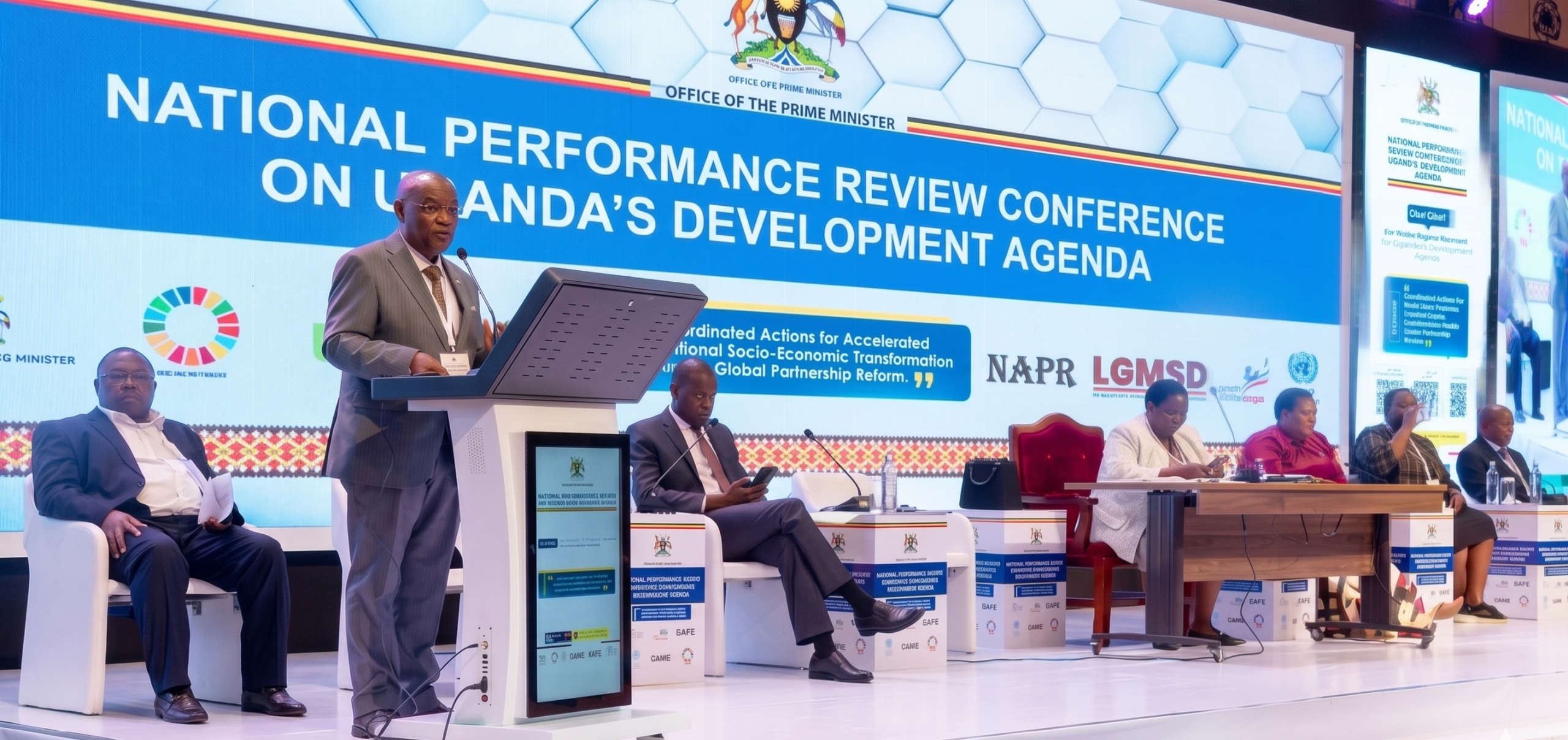
KAMPALA- Senior government officials have defended Uganda’s policy direction across governance, education, infrastructure, energy, and service delivery reforms as discussions continued at the ongoing National Performance Review Conference on Uganda’s Development held at the Speke Resort Convention Centre and chaired by Prime Minister Robinah Nabbanja.
The three-day conference has brought together cabinet ministers, technical officers, and senior policymakers to reflect on national performance, assess service delivery challenges, and strengthen implementation of government priorities across sectors.
During active discussions on local governance, the Minister of Local Government, Raphael Magezi, responded to concerns raised by participants regarding council operations, affirmative action policies, and service delivery effectiveness at district level.
On proposals suggesting that councilors should meet formal academic qualifications to effectively debate policy, Magezi rejected the idea, arguing that legislative competence is not strictly tied to education levels.
“I do not think the art of reason and debate is dependent on education qualifications,” he stated.
He emphasized that Uganda’s legal framework already allows flexibility in council proceedings, particularly regarding language use.
“The law allows a counselor to debate in local language. It is only the minutes which should be written in English,” he said.
Magezi urged reforms to follow formal administrative channels.
“In case you want a change in that law, you can, through your district chair, initiate a proposal and then we look at it,” he added.
On affirmative action, he cautioned against expanding existing frameworks.
“Selective affirmative action I think that would be going a little bit far,” he said, noting that representation of women in some councils now exceeds 40 percent.
On infrastructure, he defended the government’s one-billion-shilling district road maintenance allocation.
“When you look at District Community Access Roads before the 1 billion vis-à-vis what is there now, there is a lot of improvement,” he said.
He added that funding is primarily for maintenance. “Under the 1 billion, we are talking of maintenance mainly rehabilitation and actually even opening new roads,” he said.
State Minister for Higher Education John Chrysestom Muyingo emphasized reforms under the competence-based curriculum aimed at strengthening skilling and employability.
“Every child according to the new syllabus, which is competence-based. The issue is making government and other stakeholders assisting every Ugandan child of school-going age to go to school, stay there until he has acquired the necessary skills,” he said.
He added that even learners at lower levels are being equipped with practical skills.
“At least even if you are in S1, primary, there will be an environment created in the schools to skill you,” he said.
He also highlighted skilling centers for those outside formal education.
“They are no longer dropouts because at whatever stage, wherever they are, the government has put in place a system that skills them into either job creators,” he said.
Minister of Energy and Mineral Development Ruth Nankabirwa outlined government electrification priorities, emphasizing connection of key service delivery facilities.
“All the sub-counties that have not yet been connected must be connected according to our plan, all the Health Center IIIs that are lacking electricity connection must be connected, and all the seed schools,” she said.
She noted that seed schools are located at sub-county headquarters and remain central to electrification planning.
“The seed schools are expected to be at the sub-county headquarters,” she said.
At the same function, Minister for General Duties in the Office of the Prime Minister, Justine Kasule Lumumba, presented Uganda’s National Development Performance for FY2024/25 under NDP III (2021–2025), highlighting both progress and gaps across sectors.
She reported significant gains in agricultural compliance and productivity.
“Performance in crop and livestock productivity especially in livestock compliance had 109,500 certificates issued, which exceeded the modest target of 20,” she noted.
Lumumba also highlighted infrastructure and environmental indicators, including street lighting coverage and forest restoration trends, while cautioning that some targets remain unmet due to implementation constraints.
She further noted ongoing challenges affecting industrial transformation.
“There is growing concern over the declining contribution of manufacturing to GDP and its shrinking share in formal employment,” she said.
Chairing the session, Prime Minister Nabbanja reaffirmed government commitment to equitable access to essential services across the country, emphasizing long-term investments in health, education, and water systems.
“It is government policy to ensure equitable access to essential services across the country. This includes establishing a regional referral hospital in every region, a general hospital in every district, a Health Centre IV at the constituency level, a Health Centre III in every sub-county, a government-aided secondary school per sub-county, and a government-aided primary school in every parish,” she said.
She also highlighted progress in the water sector, noting major improvements in access over the years.
“We now have 8 in 10 households with access to improved water sources. In 1986, only 1 in 10 households had access to clean and safe water,” she said
The conference continues with further sectoral presentations as government leaders review performance, address bottlenecks, and refine strategies to accelerate Uganda’s development agenda under NDP III.