

Job Namanya | Tayari News
KABALE – The emerald-green hills of Kabale, wrapped in their signature morning mist, have long been a symbol of Uganda’s natural majesty. Yet, for the residents of Kyobugombe, these steep slopes and winding paths have historically doubled as a barrier to survival.
For years, the journey to the local health center was a trek of necessity, but once inside the doors of Kyobugombe Health Center II, a different kind of struggle began. It was a struggle against limited resources, flickering lights, and the heavy silence of a facility doing its best with very little.
Today, however, that silence has been replaced by the hum of activity and a tangible sense of renewal. In a landmark intervention launched on Wednesday under the “MTN Changemakers Initiative,” MTN Uganda, through the MTN Foundation, has delivered medical equipment and infrastructure worth Uganda shillings 20 million to the facility. This is not merely a corporate donation; it is a life-altering infusion of hope for over 8,700 residents who call these hills home.
Shadows of the past
To truly appreciate the transformation occurring today, one must understand the reality that preceded it. In rural Kabale, the arrival of nightfall often meant the arrival of danger for expectant mothers.
Patience Ahimbisibwe, a mother of three and a resident of Kyobugombe, stands near the newly installed solar panels, her eyes reflecting a mix of relief and memory.
“I remember my last birth. The sun had set, and halfway through my labour, the national grid failed. It was pitch black. The midwife was wonderful, but she was forced to work while holding a small mobile phone torch in her teeth just to see what she was doing. In that moment, you do not feel like a person, you feel like a tragedy waiting to happen. You wonder if your baby will even see the morning.,” she says, her voice lowering.

For the staff at the health center, the challenges were equally daunting.
“We are trained to save lives, but we cannot fight the dark, When the power goes out which happens often with UEDCL, we are paralyzed. We have had to deliver babies by candlelight or the glow of a few phones. It is undignified for the mother and terrifying for us. You pray that there are no complications, because if there are, you are essentially working blind,” explained Preacher Ekyarituha, the health centre in-charge.
This launch changes that narrative fundamentally. The centerpiece of the boost is a robust, comprehensive solar power system. The system ensures that the Health Center is no longer at the mercy of an unstable national grid.
Andrew Tusubira, the Commercial Head for the Western Region at MTN Uganda, addressed the gathered community with a message that resonated far beyond technology.
“Someone was talking about UEDCL being unstable. We have provided this solar system today as a permanent stop-gap measure to ensure that when the national power fails, the service here does not stop. At MTN, we believe that the benefits of a modern, connected life must go hand in hand with access to quality healthcare. Connectivity is essential, but it is most meaningful when people are healthy, empowered, and safe,” Tusubira noted, gesturing toward the new solar arrays catching the afternoon sun.
The solar system does more than just light the rooms;it powers the possibility of 24-hour emergency care. It means that the refrigeration for essential vaccines remains constant, and the sterilisation of equipment is never compromised by a blackout.
Restoring dignity to the labor ward
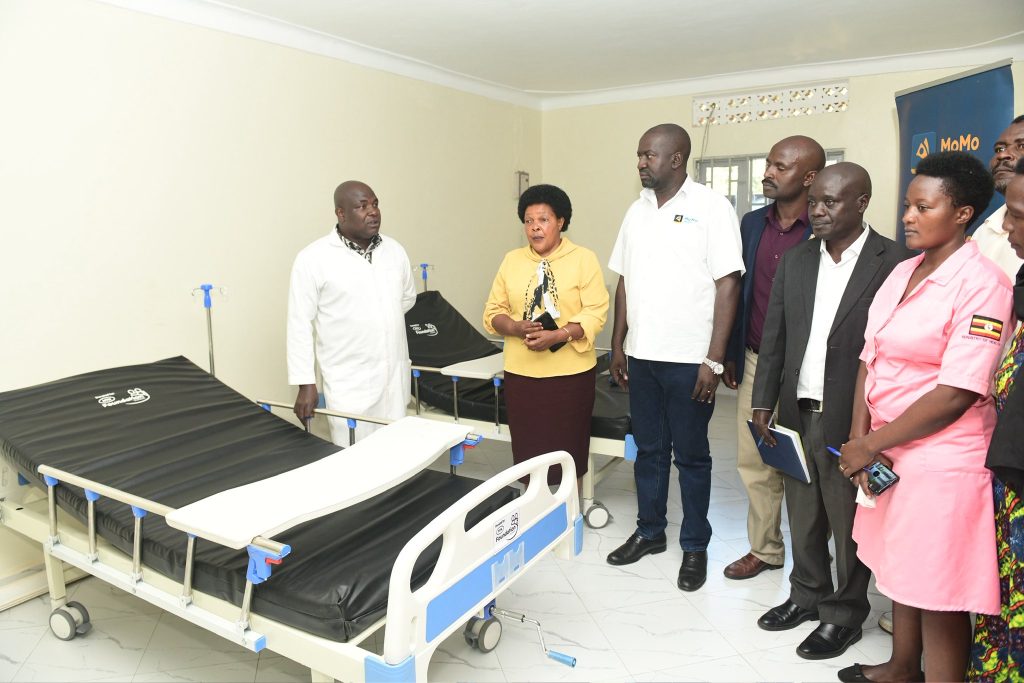
Beyond the lights, the intervention has addressed the physical comfort and safety of mothers. The donation includes state-of-the-art delivery kits and specialised maternity beds. Before this, the facility’s maternity ward was equipped with ageing, narrow beds that offered little in the way of ergonomic support or safety.
“A maternity bed is not just furniture. It is the first place a new citizen of Uganda is welcomed. These beds provide the right positioning for a safe delivery and the comfort a mother needs after the exhaustion of labour. Today, when a mother walks into this ward, she will see that she is valued. She will see that her government and partners like MTN care about her dignity,” Ekyarituha explains as she smooths the sheets on one of the new arrivals.
For women like Ahimbisibwe, the sight of the new equipment is emotional.
“Seeing these beds makes me want to tell every young mother in the village to come here. We used to fear coming to the center because it felt like a place of scarcity. Now, it feels like a place of care,” she says with a smile.
Changemaker strategy
The Kyobugombe project is a vital part of the third phase of the MTN Changemakers Initiative. The program’s philosophy is distinct, it does not seek to reinvent the wheel, but rather to grease the wheels that are already turning.
“We are supporting people and institutions that are already making a difference. The doctors, the nurses, and the local leaders here have been working tirelessly with very little. When you strengthen what communities are already doing, the impact is deeper and more sustainable. You aren’t just giving a gift; you are investing in a proven system,” Tusubira told the audience.
Since its launch three years ago, the MTN Changemakers Initiative has become one of the most impactful social investment programs in the country. It has funded over 50 community-led projects, invested more than Shs 1 billion, and reached over 235,000 beneficiaries across Uganda. In this current phase, MTN is injecting an additional Shs 500 million to support 25 projects nationwide, from vocational training centers in Nakasongola to savings associations in Mukono.
A partnership for the people
The success at Kyobugombe is the result of a coordinated effort between the private sector, local government, and community-based organizations. MTN collaborated closely with KAD Initiatives to identify the specific needs of the facility, ensuring that every shilling was targeted for maximum impact.
The Deputy Resident District Commissioner (RDC) for Kabale, Michael Kyakashari, was present to welcome the intervention.
“This support comes at a critical time for our district. Government cannot do everything alone. When partners like MTN step up to bridge the gap in maternal health and emergency response, they are directly contributing to the reduction of maternal mortality in Kabale. This facility serves 9,000 people, these lives that are safer today than they were yesterday.,” he noted.
Dr. Gilbert Mateka, the District Health Officer, emphasized that the equipment would drastically improve the facility’s referral systems. By having the tools to stabilize patients properly, the health center can now ensure that when a mother needs to be moved to a larger hospital, she starts that journey in a much better physical state.
The human connection: giving back to the roots
Underlying the celebration is a deeper story of corporate gratitude. The residents of Kabale are not just a demographic for MTN; they are the backbone of its network in the region.
“This is a community where we serve. You have supported MTN for years. You use our lines to call your loved ones, you use our data to stay informed, and you use Mobile Money to build your businesses. It is only fair and right that MTN gives back to the community that has made us who we are. We are proud to walk this journey with you,” Tusubira remarked.
The sentiment was echoed by Joram Tugeine, an elder in the Kyobugombe community who watched the proceedings with a look of quiet satisfaction.
“In my day, we did not have phones or solar power. We felt very far away from the people in the city. But today, seeing a big company come all the way to our small clinic in the hills. It makes the world feel smaller. It makes us feel like we are part of the same Uganda,” he said.
The real impact starts now
As the ceremony drew to a close and the visitors began to depart, the real work began. The solar lights flickered on as the evening mist started to roll in over the hills, but for the first time, the health center remained bright.
Tusubira left the staff with a final challenge, “Equipment alone does not create impact. The real difference will be made by you the doctors, the nurses, and the support teams. These tools are now in your hands. Use them with the skill and dedication we know you have to transform the lives of the people you serve,” he said.