
Zadock Amanyisa | Tayari News
KAMPALA – The Minister of Education and Sports, Hon. Janet Kataaha Museveni, is optimistic that the competence-based curriculum will turn around the education system in Uganda.
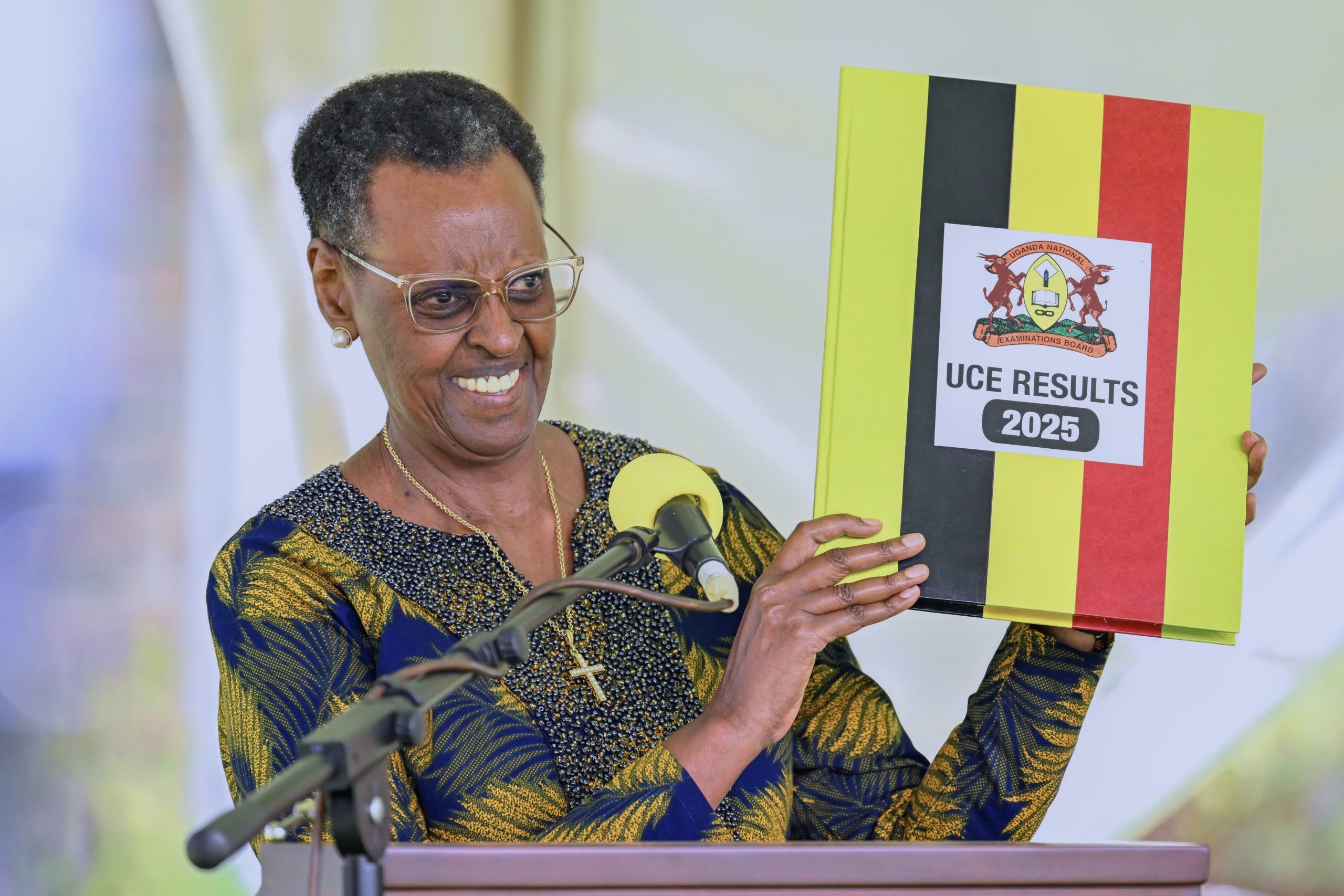
Hon. Museveni, while releasing the 2025 Uganda Certificate of Education (UCE) examination results for the second cohort of learners under the revised lower secondary curriculum that is competence-based, rolled out in January 2020, said she was excited by the outcome, attributing it to low absenteeism.
“I thank God again for the 20% increase in the total number of candidates registered for the 2025 UCE exams, with nearly 73000 additional candidates registered for the 2025 UCE exams compared with 2024. On the one hand, this increase in candidature could be attributed to the low absenteeism, which was recorded at 0.5%. This clearly indicates that more of our children who transitioned from primary to lower secondary level four years ago stayed in school to the end of the O-Level cycle.” Hon Museveni remarked
Adding that the performance leaves a lot of “curiosity as to whether the competence-based curriculum that we have adopted for O’level has influenced learner retention in the system at this level of Education at this early stage of implementing the competence-based curriculum,” the Education Minister expressed that “there is a lot of good effect this curriculum could be having and this needs to be empirically established.”
The examination body registered higher achievement levels in the 2025 Uganda Certificate of Education (UCE) results that were released on Friday. UNEB Executive Director, Dan Odongo, during the ceremony of releasing UCE results, noted that 99.69% of the candidates who sat for the UCE qualified for the certificate.
As UNEB prepared to conduct the end-of-cycle assessment for the first cohort under the New Lower Secondary School Curriculum (NLSC), now appropriately referred to as the Competency-Based Curriculum (CBC), according to Dan Odongo, the UNEB Executive Secretary, the Hon Minister of Education and Sports asked to know the difference between the learners who have gone through the new curriculum and those who went through the old curriculum. In response, UNEB conducted a study in an attempt to provide an evidence-based answer to the Hon Minister’s question.
Results showed that 93% of the Head teachers interviewed, and teachers in at least 96% of the schools surveyed, agreed that learners under the current system demonstrate stronger
problem-solving skills. The Minister said that the results from the research carried out by UNEB were so exciting to her.
She commended UNEB for being proactive and carrying out preliminary research to answer the question as to whether the competence-based curriculum is making a difference compared with the previous O-level curriculum.
Revealing that the National Curriculum Development Centre is planning to carry out a comprehensive review next financial year, looking at the implementation and the benefits of the curriculum in comparison with the previous one used at this particular level of Education, Hon. Museveni said she was happy to be part of the revolution to liberate Uganda’s education system.
“Therefore, I cannot begin to tell you how grateful I am to God today for allowing me to be part of Uganda’s generation that is striving and driving a revolution in our homeland’s Education system today. I am forever grateful and continuing to pray for NCDC, which still leads this revolution in our Education system.”
The Minister, who is also the First Lady, announced that the government, through the NCDC, has also embarked on reviewing the primary school as well as the A-level curriculum to have them fully aligned with the competence-based O-level curriculum.
“I have no doubt in my mind, therefore, that as more of our children go through this competence-based Education system, they will become wholly liberated and so shall Uganda because we are witnessing a new era in our homeland.” She said
A total of 432,163 candidates from 3,975 examination centres registered for the UCE 2025 examination, compared to 359,417 candidates in 2024, an increase of 72,746 (20.2%). Of these 204,292 (47.3%) were males, while 227,871 (52.7%) were females. 154,642 (35.8%) were beneficiaries of the USE programme, and 277,521 (64.2%) were Non-USE. A total of 429,949 (99.5%) candidates sat the examination in 2025, compared to 357,120 in 2024. Only 2,214 (0.5%) were absent. Just like in 2024, the rate of absenteeism continues to drop.